
Your App Development Decision Will Impact Your Business for Years Make It Count
You want to build a mobile app. Maybe you need to reach customers on their phones, automate your operations, or create a new income stream. It sounds like a simple job but it's not.
The real problem isn't building an app. It's picking the right company to build it. We've seen it happen dozens of times in Chennai's tech scene: a business makes one bad choice during hiring and ends up wasting 6 months, burning through budgets, and launching a product that frustrates users instead of helping them.
But here's the good news: these failures aren't accidents. They're mistakes that you can see coming and avoid.
This guide walks you through seven mistakes we see businesses make and exactly how to avoid them.
Mistake 1: Choosing the Cheapest Quote
Why the Lowest Price Usually Costs You the Most
You get quotes from three companies. One quote is way lower than the others. Your budget team is happy. You move forward.
Then the app launches, and problems start appearing. Crashes. Security holes. Poor performance. Now you're looking at expensive fixes that could have been prevented.
This happens because cheap quotes come with hidden costs cut elsewhere. Here's what typically gets sacrificed:
- Sloppy code: Works at first, but breaks when you scale up
- Weak security: Missing basic protections. Data breaches waiting to happen
- Minimal testing: The app works in the lab. Doesn't work in the real world
- No documentation: When something breaks, nobody knows how to fix it
- Zero support after launch: You're on your own when problems happen
By the time you realize this, fixing it costs 30-50% more than building it right the first time.
What to do instead:
Look at the whole picture, not just the number. Ask:
- Do they know your industry?
- What's their actual process? How do they work day-to-day?
- What support do they provide after launch?
- Can they explain how they build secure, maintainable code?
- What does your money actually include?
A slightly higher upfront cost with a solid partner saves you tens of thousands later. It's math, not opinion.
Mistake 2: Hiring a Generic App Developer for Your Specific Industry
Healthcare Apps Aren't Like Fintech Apps Aren't Like Retail Apps
Here's something people get wrong: they assume any decent app developer can build their app. That's not how it works.
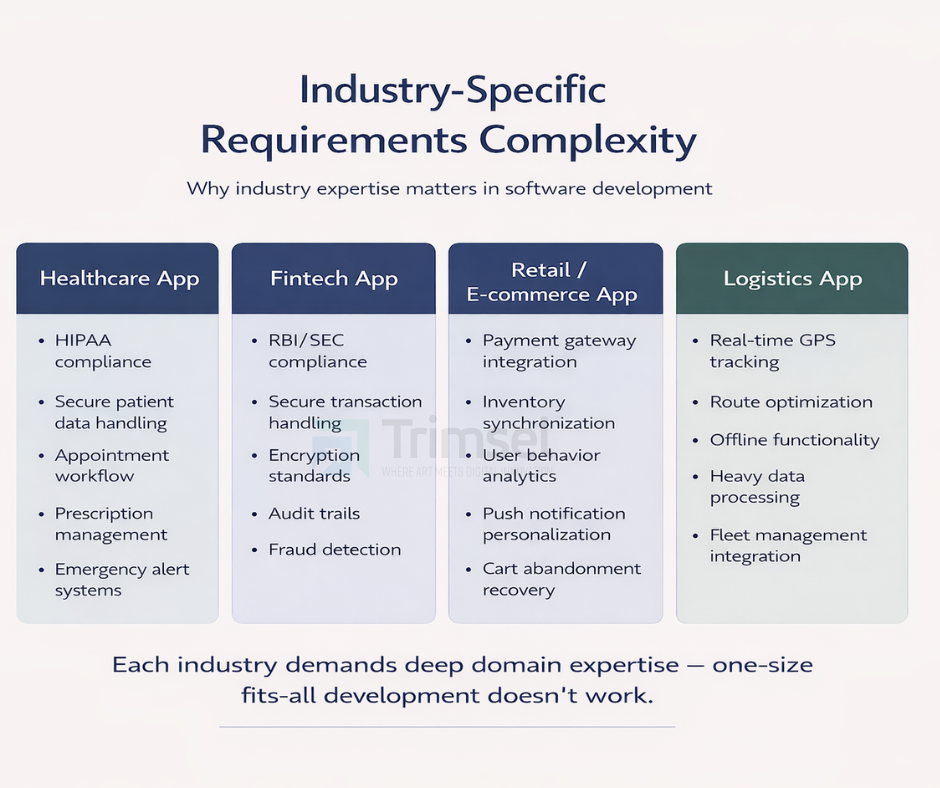
A mobile app development company in Chennai working on healthcare apps has completely different requirements than one building fintech apps. Each industry has its own rules, workflows, and problems
When a developer doesn't know your industry, they miss things:
- Legal requirements (HIPAA for healthcare, RBI rules for fintech)
- How your actual customers work (the real workflows, not the theoretical ones)
- What features actually matter vs. what sounds good in a meeting
- Security and data handling that fits your industry, not generic best practices
Example: A healthcare developer unfamiliar with HIPAA might build patient data handling that technically works but violates the law. By the time you catch this, you're redesigning the whole system. That's expensive and disruptive.
What to do instead:
Ask directly: "Have you built apps in healthcare/fintech/retail before? Show me what you built and walk me through how you handled the industry-specific stuff."
A good developer will have real examples. They'll explain the compliance issues they've navigated, the security practices they use, and the workflow patterns they've learned. They'll know your industry's problems before you explain them.
Mistake 3: Building a Gorgeous App That Nobody Can Actually Use
Beautiful Doesn't Equal Functional
We see this all the time: a company falls in love with the design. The app looks incredible. It wins design awards. Then real users try to use it. They get lost. They can't find what they need. They tap through five screens just to do one simple thing. They delete the app.
A beautiful app with bad usability is worse than an ugly app with good usability. At least the ugly app lets people do what they came to do. This happens because design decisions are visible and immediate. Making the app look great is tangible. Making it easy to use is harder to measure, so it gets skipped.
Signs you're prioritizing looks over usability:
- New users take 10+ taps to find the main feature
- Key actions are buried or unintuitive
- Nice visuals, but navigating feels random
- Designed on a desktop, doesn't work on an actual phone in someone's hand
What to do instead:
Make sure the developer thinks about how people actually use the app. Ask about their process:
- Do they build wireframes and test user flows before making it look pretty?
- Do they test with real users? Not just internal demos, but actual people?
- Do they test on actual phones in actual hands? Not just simulators
- How do they handle the fact that phones are held differently than desktops?
- Do they iterate based on user feedback?
The best apps balance how they look with how they work. Good developers show you wireframes and flows before they show you pretty designs.
Mistake 4: Not Getting Clear Ownership of Your Own App
Vague Contracts = Long-Term Problems
This is a serious mistake, and most people don't realize they've made it until years later. You assume once the app is built, you own it. Often, you don't.
Without a clear agreement in writing, you might end up:
- Can't see the source code: The developer keeps it locked up
- Stuck with the same company: You want to make changes or move to a different developer? Too bad
- Can't scale or expand: Want to add features? You need their permission
- IP disputes: Who owns the custom code? The design? The third-party tools?
This is vendor lock-in. You're trapped.
What to do instead:
Your contract needs to be crystal clear on these points:
- You own the complete source code: All of it. Unencrypted. Yours to keep.
- You own the intellectual property: Custom code, designs, everything custom-built belongs to you.
- You have direct access: GitHub, servers, hosting—you can access and control these yourself.
- Third-party tools are documented: What libraries are they using? What licenses apply?
- You can modify or extend the app without asking permission: After they're done, the app is yours to change.
Put this in the contract before work starts. Any solid company will agree to this without hesitation. If they push back, that's a red flag.
Mistake 5: Thinking the App Launch is the Finish Line
The Real Work Starts After Launch
Launching an app feels like you've crossed the finish line. You haven't. You've crossed the starting line.
After launch, everything changes. New iOS versions break things. Android updates cause crashes. Users find bugs you didn't catch. Security vulnerabilities get discovered. App store algorithms shift. User expectations change.
If nobody's watching and maintaining the app, it falls apart. Fast.
This is what happens:
- App crashes after an iOS or Android update. Users leave one-star reviews. Recovery is nightmare
- Small bugs pile up. The app gets slow and unreliable
- Security problems get exploited. Data gets compromised
- App store ratings tank. Downloads drop off a cliff
- One day something breaks badly and you need an emergency fix (which costs triple)
What to do instead:
From the first day, plan for what happens after launch. Ask potential partners:
- What do you actually do after the app launches?
- How quickly do you fix bugs when they're reported?
- How do you handle iOS and Android updates?
- What does maintenance and support cost?
- How do you monitor if the app is working?
- How often do you push updates?
A mature partner treats post-launch support as part of the job, not an afterthought. It's built into how they work, not offered as an expensive add-on later.
Mistake 6: Communication That Leaves You Guessing
You Can't Fix Problems You Don't Know About
Projects fall apart when you don't know what's happening. Issues that should be caught early blow up into major problems because nobody flagged them.
This is what poor communication looks like:
- You don't hear from the team for weeks
- Deadlines shift without explanation
- Milestones suddenly disappear
- Major changes happen without your input
- You have no idea if you're on track or off track
- Last-minute surprises appear out of nowhere
What to do instead:
Before you hire anyone, talk about how you'll stay connected:
- How often will I actually hear from you? Weekly? Every two weeks?
- What tools will we use to stay in touch? (Slack, email, project management software?)
- Who's my main point of contact? Can I reach them when I need to?
- How do you handle scope changes? What's the process?
- If something goes wrong, how do I escalate it?
A reliable partner uses project management tools. They do regular updates. You always know where things stand. Transparency breeds confidence. Mystery breeds disaster.
Mistake 7: Not Understanding the Technical Side Before You Hire
You Don't Need to Be Technical, But You Need Technical Answers
A lot of hiring decisions come down to impressive presentations rather than actual technical verification. Then the app launches and the technical problems surface.
If you're not a technical person, you might not know what to ask. That's fine. But you should still ask.
Common technical failures we've seen:
- App works with 100 users but crashes with 10,000
- Backend infrastructure is weak. APIs are slow. Database is overloaded
- Security holes. Exposed credentials. Unencrypted data. Insecure connections
- Code is a mess. Can't maintain it. Can't extend it without breaking things
- Nobody's monitoring. You don't know there's a problem until customers complain
What to do instead:
Ask for a technical overview. You don't need to understand every detail, but you need clear answers:
- If we have 10x more users, will the app still work? How are you planning for growth?
- How are you keeping data safe? What about payments? Personal information?
- What happens if the app is slow? How do you optimize it?
- How do you know if something breaks? What tools do you use to monitor?
- How do third-party tools integrate? Is that secure?
A strong developer will explain this in terms you can understand. They'll show examples. If they dodge the questions or go into technobabble without translating it, that's a problem.
Questions to Actually Ask Them
Use these to evaluate any company:
- How do you figure out if an app idea is actually worth building? (Shows if they think strategically)
- Walk me through how you actually work, day-to-day. (Reveals if they're organized or chaotic)
- What happens if I need to change something mid-project? (Shows how flexible and communicative they are)
- The app launches. Now what? (Tests if they care about long-term success)
- How do you keep an app secure? (Non-negotiable. Listen carefully)
- How do you test? What does that actually look like? (Separates quality partners from others)
- Show me an app like mine that you've built. (Proves relevant experience)
- After launch, how do you know if the app is actually working? (Shows if they're data-driven)
- Break down your pricing for me. (Prevents surprises later)
- Can you explain your technical approach in a way I'll understand? (Tests how well they communicate)
If they give thoughtful, specific answers to these, you're probably talking to someone solid. If they're vague or dismissive, keep looking.
The Real Cost of Hiring the Wrong Partner
Let's say you hire someone cheap. The app launches. Three months later, problems surface.
Now you're looking at:
- Rewriting bad code (takes months)
- Rebuilding the backend because it can't handle real usage
- Redesigning the user experience because people can't use it
- Moving data and systems around
- Getting users back after they've already left
- Dealing with security problems
In most cases, this recovery costs 30-50% more than building it right the first time. Sometimes it's cheaper to just start over. And that's the financial cost. There's also lost time in the market, damaged reputation, and frustrated teams. The math is simple: spend a bit more upfront to get it right, or spend way more later to fix it
Final Thoughts
Your app isn't a one-time project. It's a long-term part of your business. It will change. It will need updates. It will face new problems as platforms evolve. The right partner understands this. They're building for the long term, not rushing to launch and disappear.
Choosing the cheapest option. Skipping technical evaluation. Ignoring post-launch support. These feel like they save money in the short term. In reality, they're the most expensive decisions you can make.
Invest in a partner who's transparent, knows their stuff, prioritizes quality, and actually cares about your long-term success. That investment pays for itself many times over.
Ready to Move Forward?
If you're evaluating mobile app development companies in Chennai and want to talk through your project with a team that cares about quality and transparency, let's talk.
Schedule a free consultation to discuss your app idea and ask the questions that matter. Your app's success depends on this decision. Make it thoughtfully.
