
A customer messages your chatbot asking to reschedule an appointment. It replies helpfully, then someone on your team still has to open the calendar, find a slot, and confirm it manually. That gap between "the bot responded" and "the task got done" is exactly where chatbots stop and AI agents start.
If you're evaluating AI development services right now, understanding that gap and which one your business actually needs is what this guide will walk you through.
What Is an AI Chatbot?
An AI chatbot is a conversational tool that understands a user's question and responds with relevant information, but does not take independent action outside the conversation. It answers; it doesn't execute.
How Chatbots Actually Work
Most modern chatbots fall into one of two categories. The older generation uses intent matching and decision trees, the bot recognizes a set of trained phrases and routes the conversation down a pre-built path. Ask something outside its trained intents, and it either fails or loops back to a generic response.
Newer chatbots are LLM-based, meaning they use a large language model to understand open-ended questions and generate natural responses in real time, rather than matching against a fixed script. This is a meaningfully better experience, but the core limitation remains the same: the chatbot's job ends when it finishes replying. It doesn't update your CRM, check inventory, or complete a booking on its own, a human, or a separate system, still has to do that part.
Common Use Cases
Chatbots are well suited to:
- Answering frequently asked questions on a website or WhatsApp
- Qualifying leads by asking a fixed set of questions before handoff to sales
- Providing 24/7 first-line customer support
- Guiding users through simple, linear troubleshooting steps
If the job is "answer this, then hand off to a human or a form," a chatbot is usually the right and more cost-effective tool.
Businesses typically turn to AI chatbot development services when they need consistent, 24/7 coverage for support, lead qualification, or FAQs without adding headcount.
What Is an AI Agent?
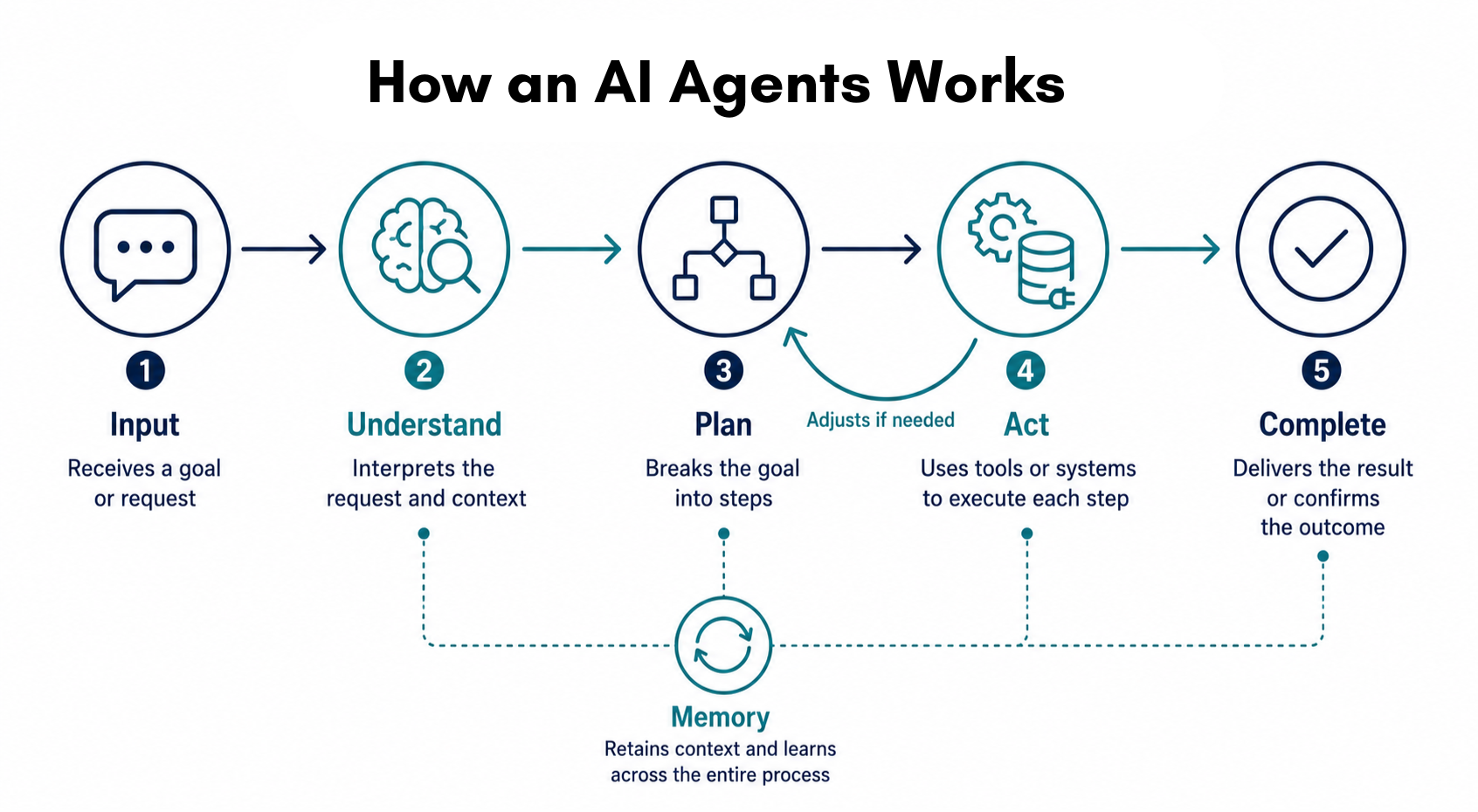
An AI agent is a system that can reason through a multi-step problem, remember context across the interaction, and take real actions like updating a database, sending an email, booking a slot, or calling other software without a human manually completing each step.
What Makes Something "Agentic"
Three capabilities separate an agent from a chatbot:
Reasoning: The ability to break a goal into steps and decide what to do next, rather than just answering a single question
Memory: Carrying context across a conversation or across sessions, so the system doesn't restart from zero every time
Tool use: The ability to actually call other systems (a calendar API, a CRM, a payment gateway, an internal database) to complete part of the task, not just describe what should happen
A chatbot with a script can tell a customer how to reschedule an appointment. An agent can actually check the calendar, find an open slot, and reschedule it.
AI Agents vs Chatbots: The Core Differences
In short: chatbots converse, agents execute. Chatbots respond to what's in front of them; agents plan across multiple steps and use memory and tools to carry a task through to completion.
Primary function
- Chatbot: Answers questions
- AI Agent: Completes tasks
Memory
- Chatbot: Little to none between sessions
- AI Agent: Retains context across steps and sessions
Takes action outside chat
- Chatbot: No
- AI Agent: Yes, bookings, updates, workflows
Handles multi-step tasks
- Chatbot: No, single-turn
- AI Agent: Yes, plans and executes steps
Typical build complexity
- Chatbot: Lower
- AI Agent: Higher
Best for
- Chatbot: Answering, routing, first-line support
- AI Agent: Executing processes end-to-end
Conversation vs. Execution
A chatbot's output is a message. An agent's output can be a completed action, a row updated, an email sent, a slot booked with the message simply confirming what was done.
Static Responses vs. Memory and Context
Without memory, every chatbot interaction largely starts fresh. Agents are built to retain relevant context, so a returning customer or an ongoing task doesn't need to be re-explained from scratch.
Single-Turn vs. Multi-Step Workflows
Chatbots are generally optimized for one question, one answer. Agents are built to handle a goal that requires several dependent steps — check availability, confirm details, then execute without a human bridging each step manually.
When a Chatbot Is the Right Choice
If your primary need is answering common questions faster and more consistently than a static FAQ page, a chatbot is very likely enough and it's the more sensible starting point.
Use Cases Where a Chatbot Is Sufficient
- Website or WhatsApp support for common questions
- Lead qualification before a sales handoff
- Basic troubleshooting for a product or service
- Internal FAQ tools for employees
Cost and Complexity Tradeoffs
Chatbot builds are generally faster and less expensive to scope, develop, and maintain than agentic systems, because they don't require integration with multiple backend systems or the additional testing that comes with letting software take real actions. For most small businesses starting their AI journey, a well-scoped chatbot is the lower-risk entry point and one that can often be expanded into an agent later, rather than needing to be replaced.
When You Need an AI Agent
If your team is spending real time on repetitive multi-step processes such as scheduling, order updates, data entry between systems that's usually the signal you've outgrown a chatbot.
Use Cases Requiring Action, Not Just Answers
- Booking or rescheduling appointments directly in a live system
- Updating records across a CRM or ERP without manual entry
- Research or data-gathering tasks that pull from multiple sources
- Multi-step customer workflows (e.g., verify eligibility, then process a request)
Signs Your Business Has Outgrown a Chatbot
- Your team still manually completes the "next step" after every chatbot conversation
- Customers regularly need to repeat information the bot should already have
- The process you want automated involves more than one system talking to another
- You're using a chatbot as a workaround for what's actually a workflow automation problem
How to Decide: A Quick Framework
Ask these questions before committing to either:
- Does the task end with an answer, or does it end with something being done?
- Does the system need to remember context across multiple steps or sessions?
- Does completing the task require touching more than one internal system?
- Would a human currently need to do something manually after the "chat" part ends.
If the answer to 2–4 is mostly no, a chatbot will likely serve you well. If it's mostly yes, you're describing an agent and treating it as a chatbot project will just mean rebuilding it again in a year.
Choosing Between a Chatbot and an AI Agent
There's no universally "better" option here a chatbot and an AI agent solve different problems, and the right choice comes down to matching the tool to what's actually happening after the conversation ends, not to how advanced either technology sounds.
The businesses that get the most value from AI aren't necessarily the ones that build the most complex system, they're the ones that correctly matched the tool to the actual task. Getting that decision right upfront saves both budget and a rebuild down the line.
