

I've spent years sitting across the table from founders staring at a cloud bill that's somehow doubled since last quarter, asking the same question: "We didn't grow that much, so why are we paying so much more?"
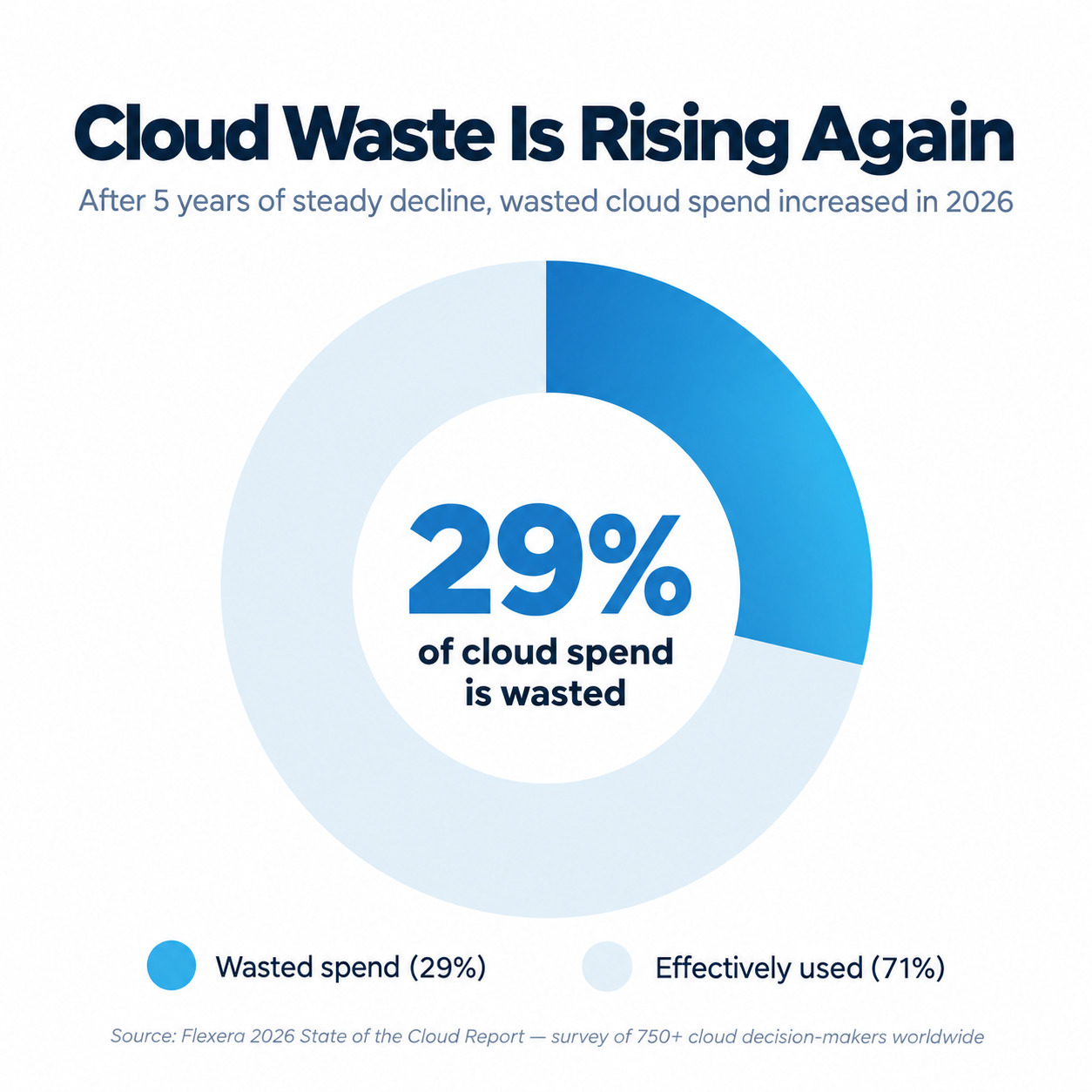
They're not imagining it. Flexera's 2026 State of the Cloud Report, a yearly survey of over 750 cloud decision-makers around the world found that businesses waste close to 29% of what they spend on cloud. And that number went up this year, after five years of getting better. Almost one in five companies went over their entire cloud budget in the past year
None of this is fraud, and it's rarely one big mistake. It's usually a few small, boring, easy-to-miss habits that quietly add up. You don't need to understand servers or code to fix any of this, you just need to know what to ask your team, or your cloud provider, the next time the bill lands.
Here's where the money actually goes, with the kind of pattern I see again and again.
1. You're paying full price for servers that run all the time
Cloud providers sell the same computing power at very different prices depending on how you buy it. Think of it like a mobile phone plan: you can pay full price every month, or sign up for a plan for a year and pay less for the same usage.
A common pattern: A business runs the same servers all day, every day, for years, with usage that never really changes, but keeps paying the full monthly rate the whole time, because nobody looked at it again after launch. Switching to even a 1-year plan for work like this usually brings that cost down a lot, often by a third or more, with no change to the app itself.
What to ask: "Are we paying full price for anything that runs all the time and never really changes?"
2. Old test servers and unused setups are still running
Every cloud account collects servers, storage, and test setups that were built for a project, a demo, or a "let's just try this" idea, and then never turned off.
A common pattern: A test version of an app, built for a launch or a demo, keeps running quietly in the background for months after everyone's forgotten about it. Nobody's using it, nobody remembers to switch it off, and it shows up as a small, easy-to-miss line on every monthly bill.
What to ask: "Can someone list everything running in our cloud account right now, and tell me what each one is actually for?" If nobody can answer that in one sitting, you're probably paying for empty rooms.
3. Your servers are bigger than you actually need
Cloud servers come in different sizes, and it's common for a team to pick a big, powerful one "just to be safe" during a stressful launch, and never check again once things settle down.
A common pattern: servers get sized for a traffic spike that only happened once, like a launch week or a big marketing push, and stay that size long after normal, everyday traffic has settled back down. Resizing servers to match what you actually use is one of the easiest wins out there, often cutting that cost by a quarter to a third, with no drop in speed.
What to ask: "When was the last time someone checked if our servers are still the right size for what we actually use today?"
4. Old, rarely-used data is stored in expensive, fast storage
Not all data needs to be available instantly. Cloud storage has "hot" storage (fast, expensive, for things you use all the time) and "cold" storage (slower, cheap, for things like old backups or records you have to keep but rarely open).
A common pattern: years of old records or backups, kept because the law requires it and opened maybe once a year, sit in the most expensive, fastest storage by default, simply because nobody moved them after they were first saved. Moving this kind of data to cheaper storage can cut that cost by more than half, with no real change in how you get to it when you need it.
What to ask: "Is any of our old, rarely-used data sitting in expensive, fast storage by default?"
5. Nobody checks spending until the bill arrives
Most businesses only check the cloud bill once a month, when it arrives. By then, a cost that started climbing weeks earlier has already added up to a big number before anyone notices. This is a big reason why waste going up again this year: newer tools like AI make bills harder to predict in the first place.
What to ask: "Do we get told right away if our spending suddenly jumps, or do we only find out once a month?"
6. Moving data in and out costs more than people expect
Keeping data in the cloud is cheap. Moving it, whether between locations, out to another provider, or just downloading a lot of it, often isn't, and this cost is easy to miss because it doesn't show up until you actually move the data.
A common pattern: a business that regularly sends large files, such as videos, backups, or big sets of data, to a partner or another system finds out that these "sending out" charges have quietly become a big chunk of the monthly bill, simply because nobody planned for this cost when the project was first budgeted.
What to ask: "Before we build something that regularly sends a lot of data in or out, has anyone checked what that actually costs?"
7. Auto-scaling has no upper limit
Cloud systems can be set to automatically add more power when traffic goes up. That's genuinely useful, until it's set up with no upper limit. A sudden spike, a bug, or even fake bot traffic can make the system keep adding power, with the bill going up right alongside it.
A common pattern: during a big sale or a sudden rush of visitors, the system automatically adds more capacity to keep up, including, sometimes, a rush that's mostly bots and not real customers, and nobody notices until the bill shows several times the usual daily cost.
What to ask: "If our traffic suddenly spiked for a bad reason, like a bug or a bot attack, is there anything stopping our costs from spiking too?"
8. No one is responsible for reviewing cloud costs
This is the habit that causes all the others: many founders treat their cloud bill the way they'd treat an electricity bill: something that just is what it is, every month, no questions asked. In truth, a cloud bill is more like a subscription you can change, shrink, or renegotiate any time, with no downtime and no risk to your product.
The businesses that don't show up tend to share one habit: someone, on a regular schedule, actually sits down and checks what's running, what's being used, and what isn't. It's a review job, not an engineering job, which is exactly why it keeps getting skipped. Nobody's job is "go find the money we're wasting," so it doesn't get found until someone makes it their job.
What to ask: "Does anyone, on our team or working with us, actually own the job of checking our cloud spend regularly? Or does it just happen to us?"
Bringing it together
None of these eight habits are dramatic on their own. What makes them costly is that they're easy to miss by default: nothing breaks, nothing looks wrong, the product keeps working exactly as it should. The bill just quietly climbs, and across the industry, that adds up to almost one in every three rupees spent.
The good news: fixing most of this doesn't need any new engineering work. It just needs someone to actually look.
If you've already gone through, or are planning, an on-premise to cloud migration, this is the natural next step: getting into the cloud the right way is one thing, staying cost-efficient once you're there is another, and it needs its own ongoing attention.
If you'd rather have someone else run this check for you, a proper look at what you're running versus what you actually need, that's exactly the kind of work our cloud consulting services are built around.
