

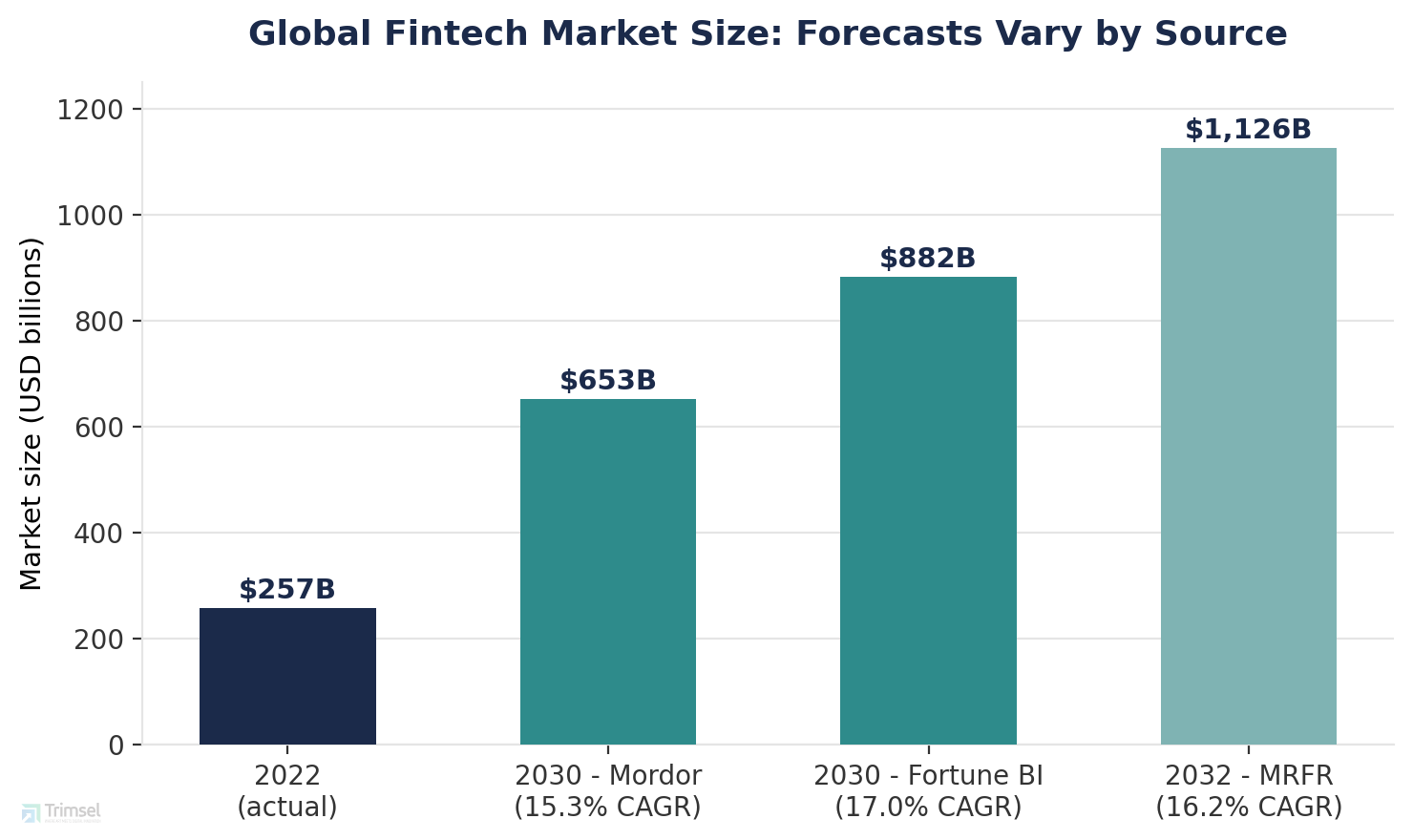
The global fintech market was valued at roughly $257 billion in 2022, and forecasts for where it lands by 2030 vary by methodology, estimates range from around $650 billion to over $1 trillion, with $882 billion at a 17% CAGR being one of the more widely cited projections.
Adoption tells a similarly nuanced story: globally, roughly 75% of consumers have adopted fintech services specifically for payments and money transfers, while broader "any fintech service" adoption sits closer to 64%. Either way, the direction is unambiguous, this is a market growing fast enough that product leaders are under real pressure to ship quickly. But fintech apps remain some of the most targeted software on the internet, and many startups in the space carry exploitable vulnerabilities they never budgeted to fix.
The businesses that navigate this well share one trait: they treat security-by-design as a starting constraint, not a final review step. Compliance frameworks like PCI DSS and GDPR get built into the core architecture from day one, rather than retrofitted after launch. That's what actually shortens time-to-market, fixing a compliance gap post-launch costs far more than designing around it upfront.
Choosing a Development Partner
Founders evaluating a development partner should look past who can ship a working app fastest and ask who can be accountable for it long after launch. The right mobile app development company treats development as a business initiative, not a coding exercise covering discovery, UX strategy, architecture, and ongoing maintenance as one continuous thread.
What to look for:
Regulatory fluency: Direct experience with frameworks like PCI DSS and ISO 27001, so the platform is audit-ready from day one rather than retrofitted later.
Relevant delivery history: A track record with financial products that handle real production transaction volume, not just prototypes.
Stack depth: Comfort with Swift/Kotlin for performance-critical native work, and Flutter/React Native where cross-platform speed matters more.
Structural accountability: One unified engineering team, not a patchwork of subcontractors. When teams are fragmented, so is ownership, it becomes unclear who's responsible for security, architecture, or fixing things when they break.
Teams that keep engineering in-house tend to hold security protocols, cloud architecture, and the product roadmap under one accountable owner throughout the build which matters more in fintech than in most other software categories.
Secure by Design, Not Secure by Afterthought
Financial platforms draw disproportionate attacker interest compared to most other software categories, which is why security has to be a design constraint from day one, not a review step before launch.
In practice, that means:
- Encryption everywhere it matters: AES-256 at rest, TLS 1.3 in transit.
- Least-privilege access: role-based controls, biometrics, and multi-factor authentication as defaults, not add-ons.
- A hardened build pipeline: automated security testing, static and dynamic analysis, and disciplined dependency management to close off supply-chain risk.
End-to-end accountability for the whole security posture rather than a patchwork of vendors each responsible for a slice of it, is consistently what separates platforms that hold up under real attack pressure from ones that don't.
Navigating Compliance
Compliance in fintech isn't a checkbox at the end, it's an architectural input from the start. KYC, AML, GDPR, CCPA, and PCI DSS all need to be mapped during discovery, especially once cross-border data sovereignty enters the picture.
The most resilient teams handle this with Governance, Risk, and Compliance (GRC) tooling built directly into the development pipeline by automating control mapping and structured audit logs, rather than compliance work done manually after the fact. Combined with strict access controls and regular security training, this reduces the human-error risk that causes a large share of real-world incidents, and turns compliance from a launch bottleneck into a genuine competitive advantage.
Features That Drive User Retention
Security and usability aren't in tension, the apps that lose users are usually the ones that get onboarding wrong. A confusing KYC flow at signup is one of the most common reasons fintech users abandon an app before they've used it once, so identity verification needs to be fast and low-friction without cutting corners on compliance.
Past onboarding, retention comes down to utility: instant transactions, real uptime, and support for the payment methods people actually use cards, wallets, and increasingly crypto. Real-time dashboards, automated budgeting tools, and AI-assisted support (chat that actually resolves things, not just deflects) are what turn a banking app into something people open daily rather than out of necessity.
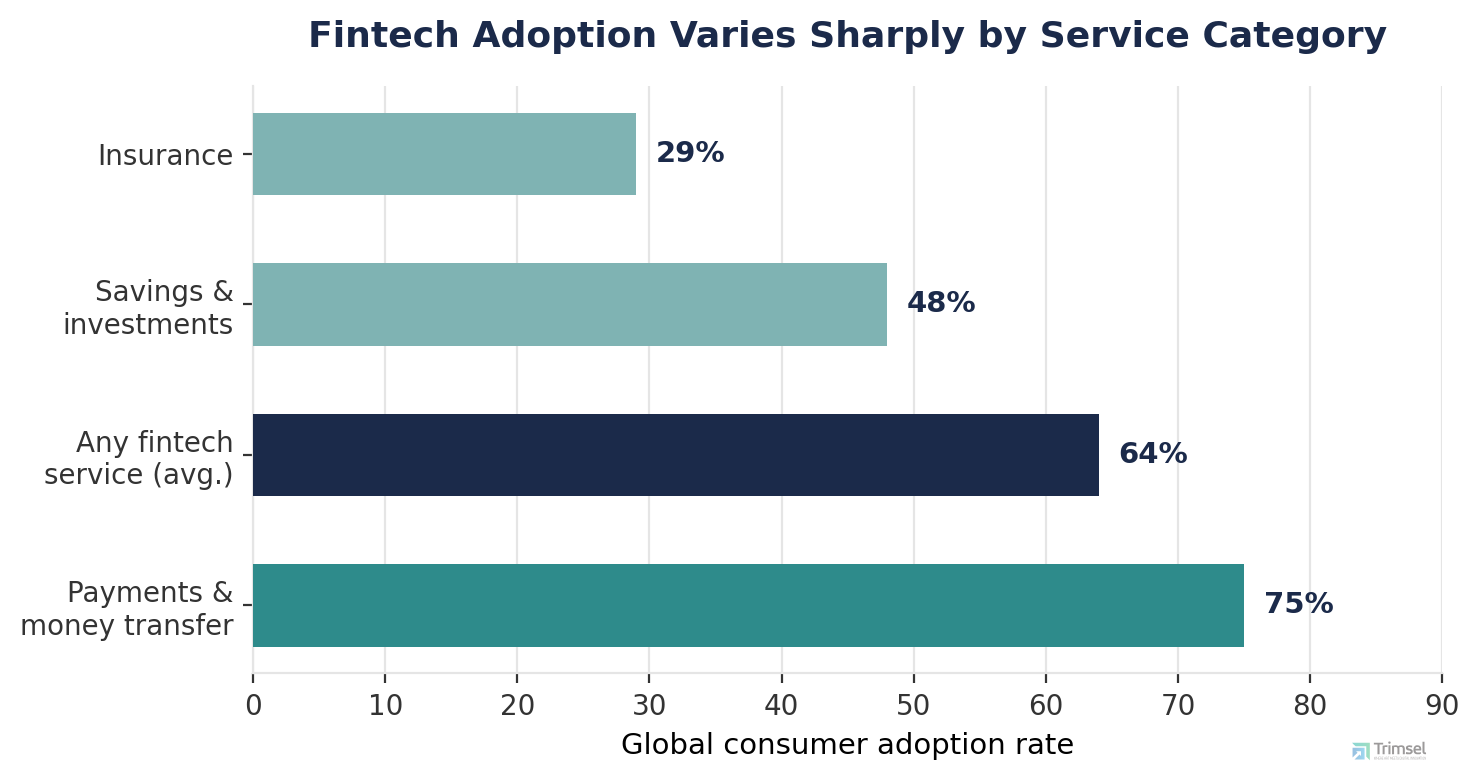
Payments consistently lead adoption because they solve an immediate, recurring need with minimal setup friction. Products further down this curve, like insurance and budgeting, succeed by borrowing that same low-friction pattern rather than assuming users will tolerate a longer onboarding for a less habitual use case.
Technology Stack
For frontend, the tradeoff is familiar: Swift and Kotlin for native performance, Flutter or React Native when speed to market matters more than squeezing out every millisecond. On the backend, Node.js, Java/Spring Boot, and Python (Django or Flask) all handle fintech workloads well when paired with OAuth 2.0 and JWT for identity, and PostgreSQL or MongoDB for transaction integrity at scale.
Cloud infrastructure choice compounds these decisions, cloud-native platforms materially reduce downtime and operational overhead versus legacy hosting. An API-first approach is what lets third-party integrations (payment gateways, Banking-as-a-Service platforms) plug in cleanly instead of requiring rework later.
Architecture for Scale
An engineering-first build prioritizes architectural integrity over feature velocity for its own sake, which is what keeps technical debt from compounding after launch. That means modular, cloud-native infrastructure, API-first integrations treated as core (not bolted on), and for teams operating in specific regions, like those building on India Stack, architecture that's designed for local interoperability from the outset.
Fraud detection is part of this foundation too: AI-driven anomaly detection built in at the architecture stage catches problems in real time without adding friction to the user experience. Getting this right early avoids the expensive re-architecture that comes from bolting on fraud detection or scale infrastructure after the fact.
Development Lifecycle and Timeline
An Agile approach consistently outperforms rigid Waterfall processes for fintech delivery, mainly because it lets teams respond to shifting compliance and security requirements mid-build rather than discovering problems at the end.
Rough timeline expectations:
- MVP: 3–6 months
- Full-featured platform: 9–12 months or more
Budget-wise, custom builds typically range from the tens of thousands into the low hundreds of thousands depending on integration complexity — and it's worth planning for roughly 15–25% of the total build cost annually afterward for maintenance, security updates, and bug fixes. Skipping that line item is one of the more common ways fintech products degrade post-launch.
Testing and Quality Assurance
Fintech QA has to go beyond "does the feature work." A layered strategy static and dynamic analysis, code review, and quarterly (at minimum) vulnerability scanning and penetration testing that catches problems during the build instead of after deployment.
At the API layer specifically: rate limiting, strict input validation, and token-based authentication close off the most common attack surfaces, like session hijacking. Every third-party integration should be audited on the same terms as internal code — a vulnerable vendor API is still your vulnerability. And a formal incident response plan, tested with real tabletop exercises, is what separates teams that recover quickly from teams that improvise under pressure.
After Launch: Maintenance and Evolution
Launch is the start of the lifecycle, not the finish line. Budgeting 15–20% of the initial build cost annually for maintenance and security updates keeps the platform compliant as regulations shift — GDPR and regional financial rules don't stand still.
Operationally, that means ongoing cloud cost and performance monitoring, automated credential rotation (tools like HashiCorp Vault handle this well), and a steady cadence of vulnerability scanning. Feature growth should follow real usage data from there — building what users actually need next, rather than what looked good in the original roadmap.
Monetization Strategy
Durable fintech products rarely rely on a single revenue line. Common, complementary models include:
- Transaction fees on payments and wallet activity
- Tiered subscriptions for premium tools or analytics
- Interest income from lending or credit products
- Affiliate revenue through financial partnerships
- B2B/white-label revenue from data or infrastructure
A freemium structure, where core functionality is free and advanced features (like automated portfolio rebalancing) are paid, tends to build trust and habit before asking for revenue, which usually pays off in retention.
AI and Emerging Technology
AI now does real work in fintech products: real-time fraud detection, automated credit scoring, and personalized insights that used to require a human analyst. Biometric authentication and behavioral anomaly detection add identity verification that's both stronger and less friction-heavy than passwords alone.
Secret management tooling for dynamic key rotation, paired with a zero-trust model where every request is verified regardless of origin, is becoming standard practice rather than a differentiator. Blockchain has a place too, particularly for transparent, immutable transaction records where auditability matters as much as speed.
Trust Through Transparency
Security architecture only builds trust if users can see it. Clear, plainly written privacy policies and terms of service, not legal boilerplate, do more for user confidence than any feature list. Visible compliance certifications (PCI DSS, ISO 27001) give users tangible proof that the internal controls are real.
Ongoing transparency matters just as much as the initial pitch: honest system status updates, responsive support, and a visible feedback loop that shows the roadmap is actually shaped by users, not just internal priorities.
Key Takeaways
Fintech success rests on four things: real security, real compliance, an experience people actually want to use, and architecture that can scale without a rebuild. Whoever owns delivery should be accountable for all four as one team, not a chain of subcontractors passing the risk along.
Start narrow. Ship an MVP that solves one problem well. Iterate from real usage, not assumptions. That's the version of "move fast" that actually survives contact with a regulator, an attacker, and a user base at scale.
