

At some point, most growing businesses reach the same moment. The cloud bill is higher than expected, a migration is on the roadmap, or a security question comes up that nobody on the team can answer. The next thought is usually, "We need someone who knows this properly."
That is when the harder question starts: which cloud consulting company should you trust? Whether you run a SaaS business in India or a growing company in any other field, a poor choice can cost you months and a lot of money. A good one saves you both.
This guide gives you 8 questions to ask before you sign, the red flags to watch for, and a simple scorecard to compare firms side by side.
When Do You Need a Cloud Consulting Partner?
Not every business needs one. These are the situations where outside help usually pays off:
- Your cloud bill keeps rising and nobody can explain why. Our guide to overpaying for cloud covers the most common causes.
- You are planning a migration. Moving from your own servers to the cloud has many steps, and mistakes are expensive to undo.
- Nobody on the team owns cloud decisions. The work gets done by whoever has time, and nobody checks it.
- You have security or compliance requirements. Your industry or your customers may require you to prove how data is stored and who can reach it.
If none of these apply, you may only need a one-time review, not an ongoing partner.
What a Cloud Consulting Partner Actually Does
A good partner covers some or all of these jobs:
- Reviews what you run today and what it costs
- Plans the right strategy for your goals
- Handles or guides the migration
- Finds and fixes wasted spend
- Sets up security and access controls
- Gives ongoing support after launch
Some firms are consultants, which means they advise you and are paid for their time. Others are resellers, which means they also sell you the cloud itself. Resellers can be a good fit, but some firms earn more when you spend more. That is why the question about payment later in this guide matters.
If your main need is faster releases and automation rather than cloud strategy, our DevOps consulting services page explains that side of the work.
8 Questions to Ask Before You Sign
Ask every firm on your shortlist the same questions. How they answer tells you as much as what they say.
1. What will I have in my hands at the end of the first phase?
Vague plans lead to vague results. Ask for the first step, the written result you will receive, and the date you will get it. A review of your current setup, delivered as a report, is a good example. If the answer is "we will get started and see," keep looking.
2. Have you worked with businesses like mine?
A SaaS startup and a manufacturer need very different things. Ask what size and type of business the firm usually helps, then ask to speak to one past client. On that call, ask what they would do differently if they started again. An honest "we have not done exactly this, but here is how we would approach it" counts in the firm's favour.
3. Who will actually do the work?
The people in the sales meeting are often not the people on your project. Ask to meet the engineers and find out who your day-to-day contact will be. If the team changes after you sign, you should hear about it first.
4. How do you earn money from this?
Firms charge a fixed fee, an hourly rate, or a monthly retainer. Some also earn extra when you spend more with a cloud provider, for example by reselling it. That is not automatically wrong, but it can shape the advice you get. A good firm explains it openly without being pushed.
5. Who will have access to our systems?
Ask what access the firm needs, who approves it, and how it is removed when the project ends. Also ask which data rules apply to your business and where your data is allowed to be stored. A firm that asks about your data before it answers is thinking about the right things.
6. What is the plan if something breaks?
Every project has problems. Ask for a plan to return to the previous setup, agreed before any work starts, along with the support hours and response times after launch. Get it in writing, not just in a call.
7. What do we keep if we stop working together?
Your cloud accounts should be in your name, and you should receive written documentation of everything that was built or changed. If a firm sets things up under its own accounts, leaving later becomes hard. Settle this before the work starts.
8. How will we know it worked?
Agree targets before the work begins, such as a lower bill, fewer outages or faster pages, and ask for regular reports. Without them, "it went well" is only an opinion.
Red Flags to Watch For
Be careful if a firm does any of these:
- Promises an exact saving before looking at your account. Nobody can know your savings until they see what you run.
- Asks no questions about your business. A good partner needs to understand your goals before suggesting anything.
- Pushes one cloud provider with no reasoning. There may be a good reason, but they should be able to explain it.
- Gives vague pricing or no written scope. If it is not written down, it is easy to argue about later.
- Wants full access to everything with no plan for who controls it. Access should be limited to what the work needs.
A Simple Scorecard for Comparing Partners
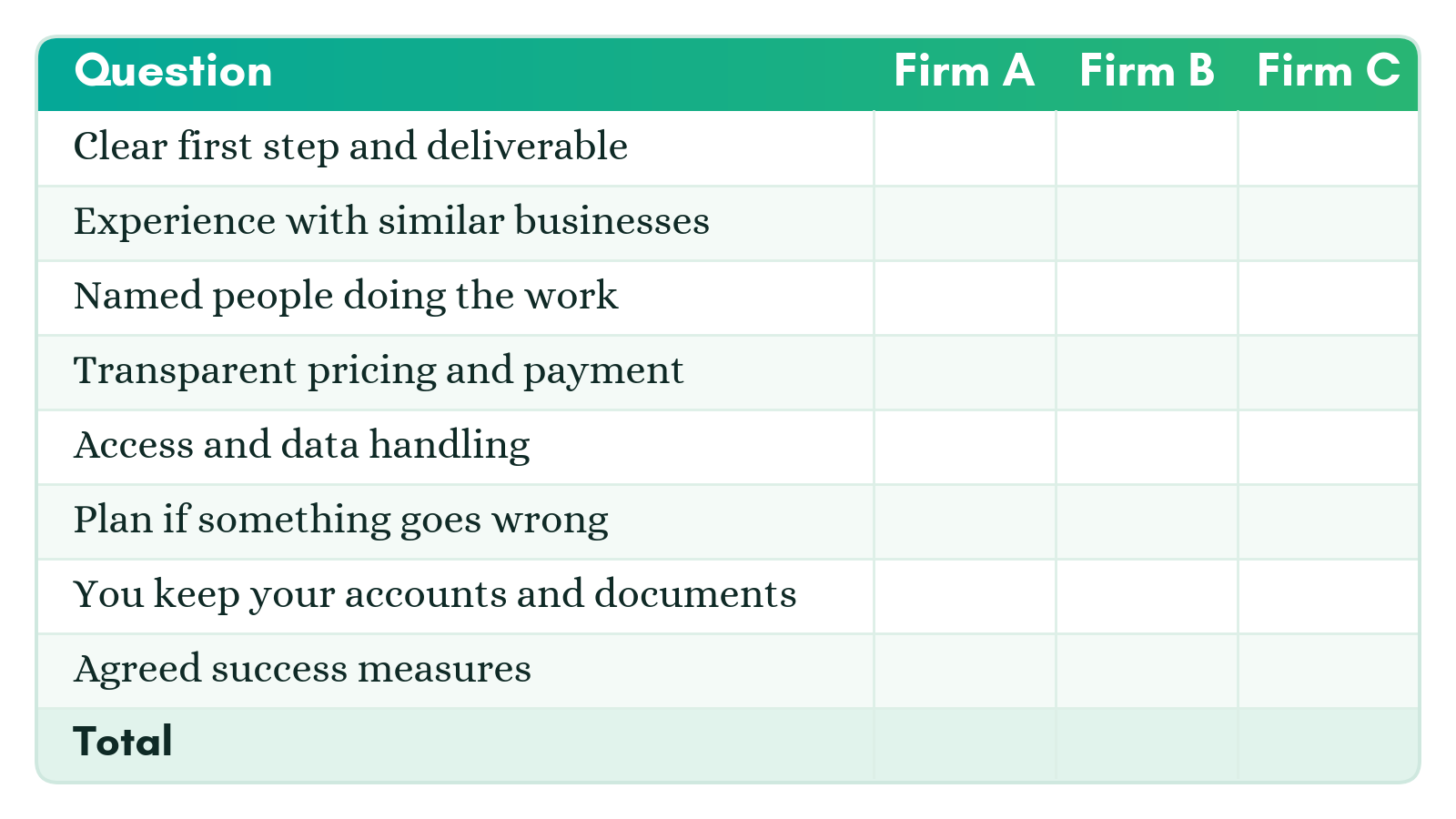
Score each firm from 1 (weak) to 5 (strong) on each question, then compare. Use the same scale for every firm, and fill it in right after each call while the answers are fresh.
Scorecard table for comparing three cloud consulting firms across eight questions, scored from 1 to 5
The eight rows to score are: a clear first step and deliverable, experience with similar businesses, named people doing the work, transparent pricing and payment, access and data handling, a plan if something goes wrong, you keep your accounts and documents, and agreed success measures.
Do not choose on the total alone. A low score on pricing transparency or ownership of your accounts is worth taking seriously, even if the firm scores well elsewhere.
How to Run the Selection in 4 Steps
- Write down your goals. For example: cut the bill, move to the cloud by a certain date, or pass a security review.
- Shortlist three firms. More than three makes it hard to compare properly.
- Ask all three the same 8 questions. Take notes and fill in the scorecard.
- Start small. Begin with a small paid project, such as a review of your current setup, before committing to a long contract. It shows you how the firm works at low risk.
Common Mistakes When Choosing a Partner
- Choosing only on price. The cheapest quote often leaves out work you will need later.
- Skipping references. A short call with a past client tells you more than any proposal.
- Not getting the scope in writing. Spoken promises are hard to hold anyone to.
- Not checking who owns the cloud accounts. Sort this out before the work starts, not after.
- Comparing quotes for different work. Make sure every quote covers the same tasks.
Get Help Choosing the Right Cloud Setup
Use these same questions on us too. If you want a second opinion on your cloud setup before you decide, our cloud consulting services are built around exactly this kind of work, from the first review through to ongoing cost checks.
